Plinko in South Africa: Risk Levels, Rows and Where to Play
Plinko is the simplest game on this site and the one most often misunderstood. A ball drops through a triangle of pegs and lands in a slot with a multiplier. The two settings you control look cosmetic and are not: they reshape the entire distribution of what can happen.
On this page
What Plinko looks like
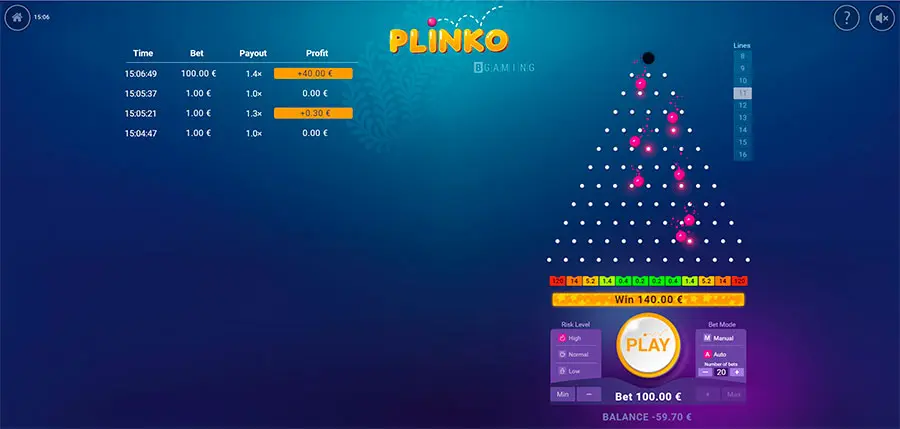
Images: BGaming, official page of its version of the game (bgaming.com).
How Plinko works
You drop a ball from the top of a triangular board of pegs. It bounces left or right at each peg on the way down and lands in one of the slots along the bottom. Each slot carries a multiplier applied to your stake. That is the whole game.
The slots are not equal. The ones in the middle carry small multipliers, often below 1x, and the ones at the outer edges carry the large ones. The board's geometry means the middle is where most balls land and the edges are where almost none do. This is not a quirk, it is the design: it is how the game pays out large multipliers at all while still holding an edge.
Two controls change the shape of that distribution, and they are the only real decisions in the game.
The two settings that matter
Everything else on the screen is presentation. These two decide what kind of session you are about to have.
- Risk level. Low risk flattens the payout table: the middle slots pay closer to your stake and the edges pay less spectacularly. High risk does the opposite, hollowing out the middle so most drops return very little and the rare edge hit is large. On BGaming's 16-line board the edges read x16 on low risk and x1000 on high, and the middle x0.5 against x0.2 (our reading of its free demo). In Spribe's version the colour of the ball plays that part: its page describes three coloured buttons, and its screenshots show a row of multipliers for each.
- Number of rows. More rows means more pegs, more bounces and a wider board. That pushes the extreme multipliers higher and makes them rarer, because the ball has more chances to drift back toward the middle. Fewer rows tightens everything up: on high risk, BGaming's board tops out at x29 with 8 lines and at x1000 with 16 (our reading of its free demo).
- The two together. High risk with many rows is the most volatile configuration in the game: long stretches of near-total loss punctuated by occasional large hits. Low risk with few rows is the calmest. Neither BGaming's rules nor Spribe's page gives a return for a particular setting, but choosing one without knowing what it does is how people burn a budget in ten minutes by accident.
Two of the games called Plinko, side by side 🔍
This is the single most useful thing to know before you play Plinko anywhere. Many studios publish a game called Plinko, and they are not the same product: the operators on this page carry versions from BetGames, Split the Pot, SmartSoft, Turbo Games, Funky Games, RTG and others. The table sets two of them side by side, BGaming's and Spribe's, with what each studio publishes about its own version; a dash means the studio's own page gives no figure.
Swipe the table sideways to see every column.
| Studio | RTP | Max win | Rows | Released |
|---|---|---|---|---|
| BGaming | 98.91% - 99.16% by the rules of its demo; 99% on its game page | 1,000x | 8 to 16 | 2019 |
| Spribe | 97% | - | Adjustable; 14 pins in its screenshots | 2019 |
Why that difference matters more than it looks
About two percentage points of return separate the two: 97% at Spribe against 98.91% to 99.16% at BGaming. By our arithmetic, R1,000 of drops costs R30 on average at 97% and R8.40 to R10.90 at BGaming's figures. Over a session of a few hundred drops that is the difference between a game that grinds slowly and one that grinds noticeably faster, and auto-drop makes hundreds of drops easy to reach.
The ceiling is harder to compare. BGaming's page gives a maximum multiplier of 1,000x, and its demo shows x1000 at the edges of the 16-line board on high risk. Spribe's page gives no maximum: the board in its screenshots, set to 14 pins, tops out at 353x on the red row, and its page says the number of pins can be adjusted, so that figure describes one board rather than the game.
Row count is a setting rather than a version difference, but the available range is set by the studio. BGaming's rules offer 8 to 16 lines. Spribe's page says only that the player can adjust the number of pins, and its screenshots show 14.
Open the game's rules to see whose version it is: BGaming's names the studio there and under the logo. The operator list at the bottom of this page names the versions we found in each lobby, and SmartSoft's version is a different game again, with its own rules, on the PlinkoX page.
Auto-drop: set your limits first
Both versions in the table can drop balls for you. BGaming's rules describe an Auto mode in which you choose the number of bets and press Play, and let you start another round with the same settings before the last ball has landed; its rules page adds that Auto mode 'can be unavailable in the game because of the requirements of the license that regulates the operator's work'. Spribe's screenshots show an autoplay panel offering 3, 10, 25, 100, 200 or 500 rounds. Auto-drop is a quick way to lose money, and not because the game is rigged: speed multiplies exposure.
A game with a house edge returns less than you stake over time. The more rounds per minute, the faster that arithmetic plays out: by our arithmetic, 500 drops of R2 at Spribe's 97% cost R30 on average, and the screen makes it feel like nothing much is happening.
If you use auto-drop, set a stop condition before you start: a number of drops, a loss limit, or both. The panel in Spribe's screenshots offers 'Stop if cash decreases by' and 'Stop if single win exceeds'. The feature is fine. The feature with no stop condition is not.
How to start playing Plinko in rand
Short, because the game is short.
-
Check which version the operator carries
Several studios make a Plinko. Payout tables and RTP differ between them, so the version matters. -
Register and complete FICA
As always, before you need it rather than after. -
Try the settings before you deposit
Drop a few balls on low risk, then on high risk. The difference is obvious in thirty seconds and impossible to describe as convincingly as seeing it. -
Pick your configuration and a stop condition
Especially if you plan to use auto-drop.
Plinko RTP and volatility 📊
Several studios give Plinko's return to player as 97% (Spribe) to 99.16% (BGaming).
In Plinko you choose the volatility yourself.
Top payout: 1000x (BGaming).
Paying for Plinko in rand
Plinko is in the lobby at 18 operators we list: all of them take cards; 14 take Ozow; 12 take Capitec Pay; 15 take cash vouchers.
The smallest first deposit for Plinko among them is R1, at Hollywoodbets and Luckyfish.
Plinko winnings are paid by EFT to an account in your own name, after FICA.
Get FICA done first · How to deposit in rand · Every payment method
Is Plinko legal in South Africa? 📜
Plinko is a casino-style game, which licensed bookmakers carry under their provincial betting licences.
15 of the 18 operators we list for Plinko hold a South African provincial licence. SilverSands (Government of the Autonomous Island of Anjouan, Union of Comoros) and Springbok (Curacao Gaming Commission) are licensed outside South Africa, so a dispute there does not reach a provincial board.
Before you play with real money ⚠️
Set your Plinko budget and a deposit limit before the first round, not after a losing one. If it stops being fun, the South African Responsible Gambling Foundation helpline is free on 0800 006 008.
Pros, cons and verdict ⚖️
- Nothing to learn; you understand it on the first drop
- Risk and row settings give genuine control over volatility
- Very light on mobile data
- Auto-drop makes it the easiest game here to overspend on
- Different studios ship different payout tables under the same name
- No skill element at all, in either direction
Plinko is honest about what it is, which is more than can be said for a lot of games. The settings are a real lever on volatility and worth using deliberately. The danger is purely mechanical: auto-drop plus no stop condition turns a decided budget into an undecided one faster than anything else on this site. Set the stop first, then enjoy the game.
Plinko FAQ ❓
Does risk level change the RTP?
In BGaming's version the return moves with your choices: its rules give 98.91% to 99.16% 'depending on the player's chosen strategy', without saying which setting gives which. Spribe's page gives one figure, 97%. In both, the setting changes the spread of outcomes, so read the game's own information screen for the version your casino carries.
Do more rows mean better odds?
Nothing in BGaming's rules or on Spribe's page says so. More rows raise the top multipliers and make them rarer: on high risk, BGaming's board goes from x29 at 8 lines to x1000 at 16 (our reading of its free demo). Its return moves only within 98.91% to 99.16%, a quarter of a point by our arithmetic, and its rules tie neither end to a setting.
Is there a Plinko strategy?
There is no way to influence where a ball lands. BGaming's rules tie its return to 'the player's chosen strategy' without saying which choice gives which. The only real decisions are risk level, row count, stake size and when to stop.
Which Plinko is at South African operators?
It varies by operator, because several studios publish a version. Each row in the list at the bottom of this page names the ones we found at that operator, and they differ: some lobbies carry five or six studios' versions, others just one.
Where to play Plinko in South Africa
Operators we have found carrying Plinko, each with its licence and our score, and the date where we saw the game in the lobby ourselves. Ordered by that score. How we score Offers checked September 2026.


Also carrying Plinko. Bonus, payment and payout terms for each are on its review.